Impacts of Proposed Federal Supplier Climate Risks and Resilience Rule
On Nov. 10, the Biden-Harris Administration announced its proposed Federal Supplier Climate Risks and Resilience Rule, which is expected to impact both domestic and international markets.
The federal government is the world’s largest single buyer of goods and services — including more than $630 billion purchased in the last fiscal year alone. As a result, the requirement for federal contractors is estimated to cover approximately 85 percent of the emissions associated with the federal supply chain, which are more than twice as large as the emissions from operating the federal government’s 300,000 buildings and 600,000 vehicles combined, affecting upwards of 5,700 individual supplier organizations.
Emissions and Risk Reporting
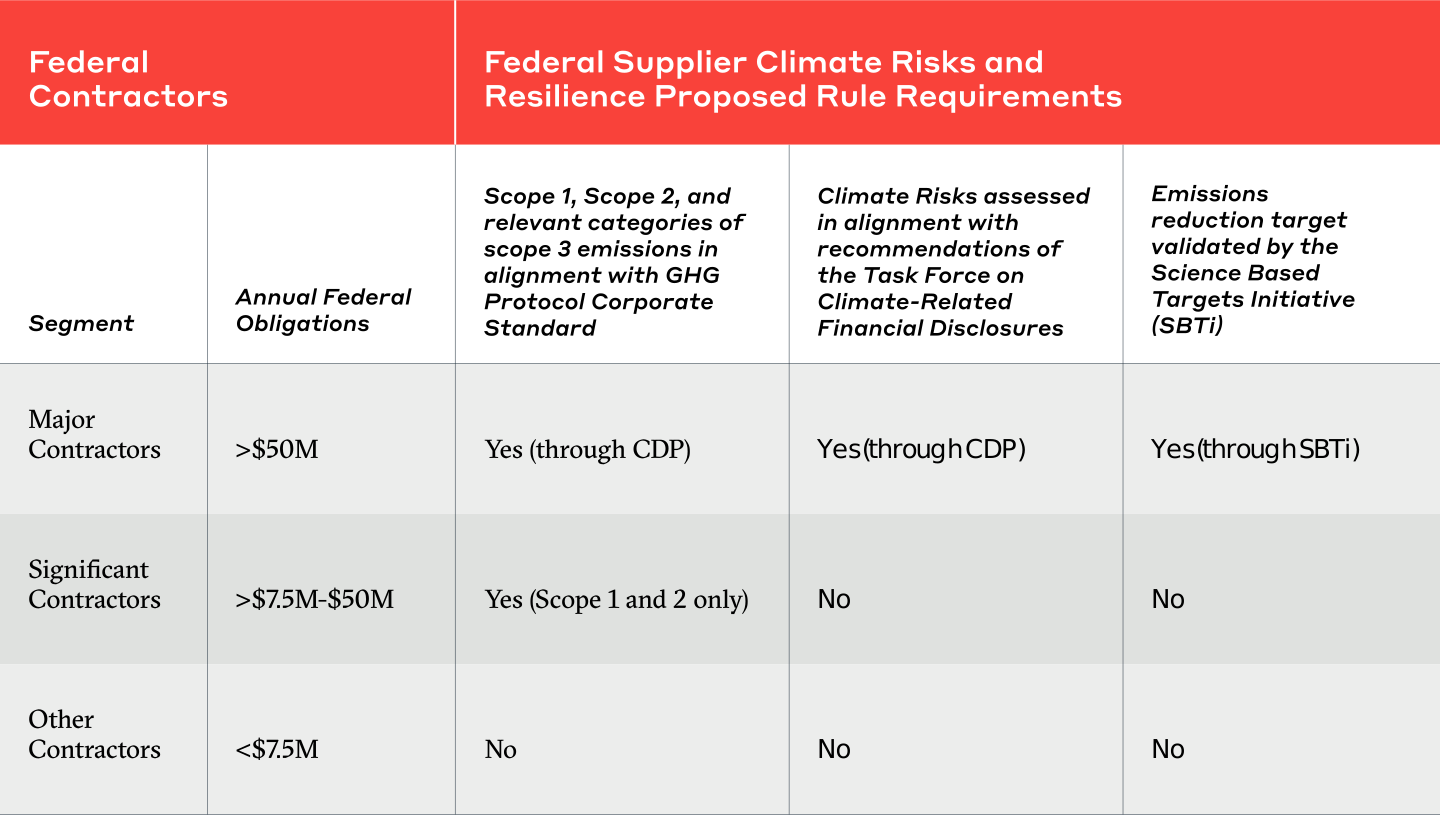
Under the proposed rule, federal contractors receiving more than $50 million in annual contracts will be required to publicly disclose annual Scope 1, Scope 2 and relevant categories of Scope 3 greenhouse gas (GHG) emissions, as well as climate-related financial risks through CDP (formerly the Carbon Disclosure Project) and set science-based emissions reduction targets.
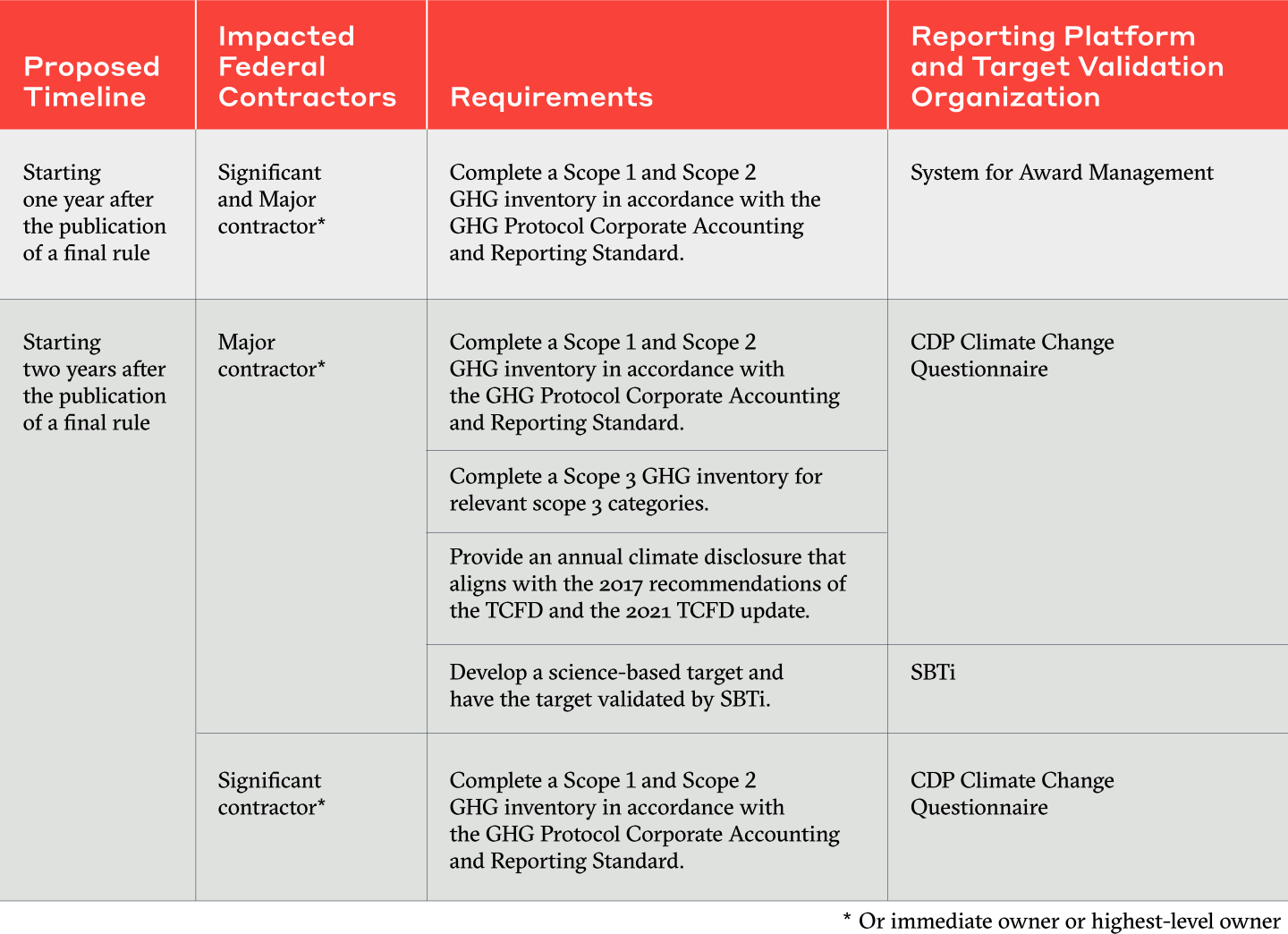
Starting one year after publication of a final rule, significant and major contractors (or their immediate owner or highest-level owner) must annually report Scope 1 and Scope 2 GHG emissions. The emissions must be posted in the System for Award Management (SAM) in this first phase according to the proposed rule. This allows time for significant and major contractors to get familiar with the CDP Climate Change questionnaire and start to report through CDP in the second phase.
Two years after publication, major contractors must also inventory relevant Scope 3 GHG emissions as part of their CDP Climate Change questionnaire responses. At the same time, they must provide an annual climate disclosure that aligns with the 2017 Final Recommendations of the Task Force on Climate-Related Financial Disclosures (TCFD) and the 2021 TCFD Implementing Guidance Annex.
Major contractors must also provide annual climate disclosures by completing those portions of the CDP Climate Change questionnaire that align with the TCFD. Companies following the TCFD recommendations will assess two types of climate risks: transition risks and physical risks associated with climate change.
“Transition risks are associated with the transition to a lower-carbon global economy — the most common are related to policy and legal actions, technology changes, market responses and reputational considerations,” S7Clear. “Physical risks, on the other hand, are associated with climate change, which could be event-driven like the increased severity of extreme weather events, as well as longer-term shifts in precipitation patterns, annual average temperatures, and sea level rise.”
At this point, major contractors will also be required to develop a science-based target, which will need to be validated by the Science Based Targets initiative (SBTi).
A Commitment to Net Zero
The proposed rule is an integral part of the President’s Federal Sustainability Plan, which set a goal of net zero emissions in procurement by 2050. In addition to working closely with a wide range of clients to support their emission reduction efforts, S7Clear has itself set ambitious sustainability targets.
Source: https://www.sustainability.gov/federalsustainabilityplan/fed-supplier-rule.html